


Medical Science Liaisons
Find and connect with your Medical Affairs Contact, also known as Medical Science Liaison (MSL), in your region and specialty.

>70%1,2
of women may develop uterine fibroids by the onset of menopause
25%1,3
experience debilitating symptoms requiring treatment
The annual direct costs for uterine fibroids in the United States are estimated at $4.1-$9.4 billion.
Uterine fibroids have a high burden of disease:
Uterine fibroids may be asymptomatic or cause chronic, severe symptoms. Symptoms are often insidious, and many cases remain undiagnosed.1
1. Stewart EA, et al. BJOG. 2017;124:1501-1512. 2. Baird DD, et al. Am J Obstet Gynecol. 2003;188:100-107. 3. Islam MS, et al. Fertil Steril. 2013;100:178-193. 4. Cardozo ER, et al. Am J Obstet Gynecol. 2012;206:211.e1-e9. 5. Merrill RM. Med Sci Monit. 2008;14:CR24-CR31. 6. Wright JD, et al. Obstet Gynecol. 2013;122:233-241 7. Whiteman MK, et al. Am J Obstet Gynecol. 2010;202:541.e1-541.e6.
Uterine fibroids, also known as leiomyomas, are benign pelvic tumors that develop in smooth muscle tissue at various locations in the wall of the uterus.1-4
The complete pathophysiology is not fully understood.
Reproductive hormones drive the formation and growth of uterine fibroids.7
1. Vilas GA, et al. J Obstet Gynaecol Can. 2015;37:157-178. 2. Stewart EA, et al. BJOG. 2017;124:1501-1512. 3. Baird DD, et al. Am J Obstet Gynecol. 2003;188:100-107. 4. Lippman SA, et al. Fertil Steril. 2003;80:1488-1494. 5. Katz TA, et al. Fertil Steril. 2016;106:967-977. 6. Makinen N, et al. Oncotarget. 2011;2:966-969. 7. Reis FM, et al. Best Pract Res Clin Obstet Gynaecol. 2016;34:13-24.
Fibroids are frequently discovered incidentally during a routine bimanual pelvic exam when physicians detect irregularities in uterine size and shape.1-3
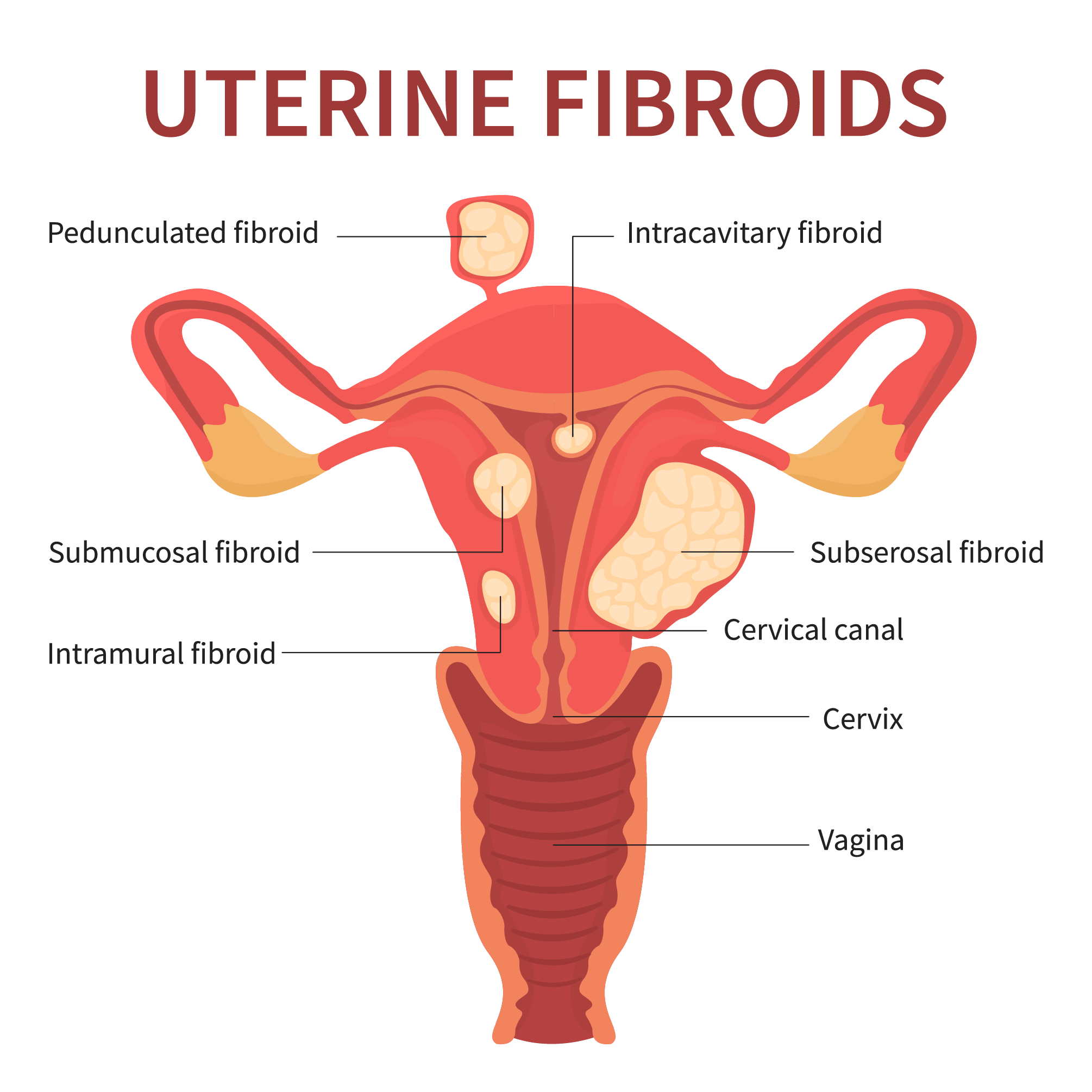
Fibroid classification is based on anatomical location: submucosal, intramural, subserosal, and other. Determining the location of uterine fibroids is important, as it may affect the type of symptoms experienced.
Submucosal
associated with anemia, most likely to cause bleeding
Subserosal
may cause pressure and pelvic discomfort
Other symptoms associated with uterine fibroids8:
FIGO, International Federation of Gynecology and Obstetrics; MRI, magnetic resonance imaging.
1. Mayo Clinic. Uterine Fibroids. Available at https://www.mayoclinic.org/diseases-conditions/uterine-fibroids/diagnosis-treatment/drc-20354294. Accessed April 28, 2026. 2. ACOG Practice Bulletin No. 228. Obstet Gynecol. 2021;137:e100-e115. 3. Mas A, et al. Int J Womens Health. 2017;9:607-617. 4. Munro MG, et al. Int J Gynecol Obstet. 2011;113:3-13. 5. Puri K, et al. Am J Obstet Gynecol. 2014;210:e1-7. 6. Bulun SE. N Engl J Med. 2013;369:1344-55. 7. Al-Hendy A, et al. Semin Reprod Med. 2017;35:473-480. 8. Fuldeore MJ, et al. Intl J Womens Health. 2017;9:403-411.
External education resource focused on uterine fibroids and patient support.
View ResourceFind and connect with your Medical Affairs Contact, also known as Medical Science Liaison (MSL), in your region and specialty.
Stay informed and stay current with updates delivered directly to your inbox.
Submit a request for more information.
+ 1 (800) 739-0565Monday - Friday, 8 AM - 8 PM ET
Please report any side effects related to any Sumitomo Pharma America, Inc. medication by contacting us. You may also contact the US Food and Drug Administration (FDA) directly by visiting www.fda.gov/Safety/MedWatch or calling 1-800-FDA-1088.
